
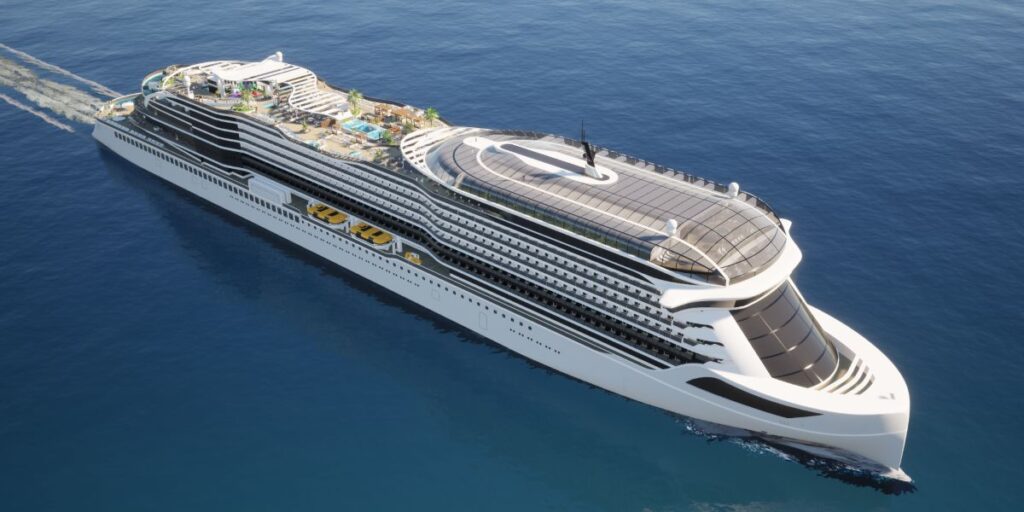
A groundbreaking development in cruise travel is on the horizon. German shipbuilder Meyer Werft has unveiled a concept for a fully battery-electric cruise ship, potentially setting sail within the next decade. Known as Project Vision, this innovative vessel could carry nearly 2,000 passengers, offering a more sustainable way to explore the seas.
The ship, revealed at Seatrade Cruise Global in Miami, is designed to be approximately 902 feet long. It can accommodate 1,856 guests and boasts a gross tonnage of around 82,000. The most striking feature of Project Vision is its potential to cut greenhouse gas emissions by up to 95% compared to traditional cruise ships. This is achieved by replacing conventional propulsion systems with a large-scale battery installation from Norwegian company Corvus Energy.
Unlike current ships that use liquified natural gas or marine diesel engines, Project Vision would rely entirely on stored electrical energy for certain routes. Tim Krug from Meyer Werft’s Concept Development Group emphasised the urgency of reducing CO2 emissions, stating that the technology to build such a vessel is already available. Chief sales officer Thomas Weigend added that a ship ordered today could be ready by 2031.
Design Built Around Shorter, Regional Cruises
Project Vision is tailored for shorter itineraries, especially in regions with port infrastructure that supports frequent recharging. Many popular European routes could be completed entirely on battery power. For instance, sailings between Barcelona and Civitavecchia are highlighted as potential examples. The success of these operations hinges on shoreside charging capabilities, with around 100 European ports expected to have the necessary infrastructure by 2030.
This development is largely driven by the European Union’s Fit for 55 climate initiative. The policy aims to reduce emissions by at least 55% by 2030 compared to 1990 levels, working towards climate neutrality by 2050. Under these rules, ships visiting EU ports must connect to shore power and account for their carbon emissions, pushing cruise lines to adopt cleaner technologies.
Rethinking Cruise Ship Design
The absence of conventional engines and exhaust systems in Project Vision allows for a complete redesign of onboard spaces. Without the need for funnels and internal exhaust structures, more space can be dedicated to passenger areas, particularly on upper decks. The concept includes an expanded open-air sun deck, offering passengers more leisure space.
For longer voyages, Meyer Werft suggests adapting the concept into a hybrid configuration. This would involve supplementary generators to extend the vessel’s range, making routes like transatlantic crossings feasible while still achieving significant emissions reductions. This innovative approach could revolutionise the cruise industry, offering a greener and more enjoyable experience for holidaygoers.

Leave a Reply