
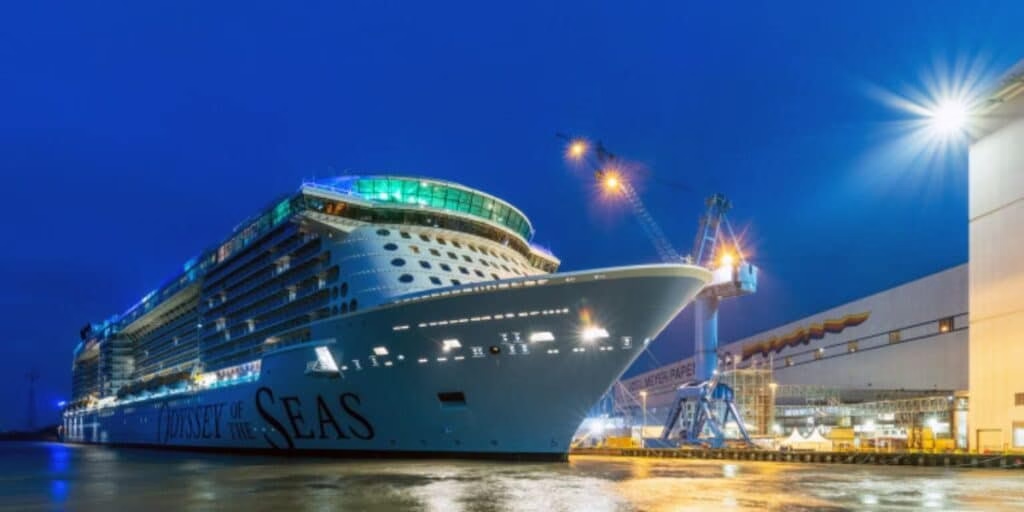
The Italian Coast Guard successfully airlifted an ill passenger from Royal Caribbean’s Odyssey of the Seas on 16th October 2026, in challenging conditions that included 25mph winds and waves exceeding six feet.
The 64-year-old guest was evacuated from the vessel whilst it was sailing 120 miles east of Sicily in the Ionian Sea and transported to hospital in Catania for urgent medical treatment.
The Guardia Costiera posted footage of the complex medical evacuation on Sunday, 18th October 2026, showcasing the precision and skill required for such operations at sea.
The brief 30-second clip shows the rescue helicopter Nemo 10, an AW139 aircraft operated by the Catania Coast Guard Air Base, approaching the moving cruise ship before executing the delicate extraction.
The video clearly demonstrates the challenging nature of the operation, with Odyssey of the Seas visibly cutting through choppy waters whilst maintaining course.
One rescue specialist descended to the ship’s deck with a passenger litter, securing the ill guest before both were hoisted back to the hovering aircraft above.
Operation Conducted During Full Day At Sea Between Port Calls
According to passengers on the ship’s Facebook group for the 11th October 2026 sailing, the airlift took place at approximately 2pm local time on Friday, 16th October.
At that moment, Odyssey of the Seas was experiencing a full day at sea between port visits, having departed Mykonos on Thursday, 15th October, and heading towards Naples for its final scheduled port call on Saturday, 17th October.
The 4,198-guest vessel was operating a seven-night Greece and Italy itinerary sailing roundtrip from Civitavecchia (Rome), one of Royal Caribbean’s popular Mediterranean offerings from the port that serves as the gateway to Italy’s capital city.
This particular itinerary has proven consistently popular with guests seeking to explore iconic destinations across both countries in a single voyage.
Adverse Weather Conditions Added Complexity To Evacuation
The Italian Coast Guard’s official caption accompanying the video highlighted the difficult circumstances under which the rescue was performed.
Waves in the Ionian Sea measured more than two metres (approximately 6.5 feet) high, whilst northerly winds reached 22 knots, equivalent to 25 miles per hour.
These conditions would have created significant motion for both the cruise ship and the hovering helicopter, making synchronisation between the two vessels absolutely critical for a safe evacuation.
The rescue crew had to account for the ship’s forward momentum, the helicopter’s position relative to wind direction, and the vertical movement caused by the swells passing beneath the vessel.
Cruise ship crew members can be seen in the footage providing essential assistance by maintaining tension on a tagline attached to the litter.
This crucial technique helps stabilise the litter as it’s winched
Leave a Reply